
On-Demand Courier App Development: Complete 2026 Guide
The global courier delivery market is experiencing explosive growth, with projections showing 5.4%-7.6% CAGR through 2035, and consumer expectations have fundamentally shifted in 2026. Same-day delivery is no longer a luxury—it’s an expectation. If you’re a business owner, startup founder, or CTO considering building an on-demand courier app, you’re entering one of the most lucrative and competitive markets in tech today.
But here’s the challenge: courier delivery app development isn’t just about slapping together a map and payment system. You need real-time tracking, intelligent route optimization, multi-panel architecture, compliance across regions, sustainable practices, and AI-powered features that reduce last-mile costs by 15-20%.
That’s why Read Authentic prepared this detailed, comprehensive guide to help you navigate every decision—from architecture to monetization.
In the next sections, you’ll discover:
15+ must-have features for a market-ready courier app in 2026
Exact development costs ($20K-$500K+) and realistic timelines
5 proven business models that actually generate profit
2026 technology trends dominating logistics
Step-by-step development roadmap from zero to launch
Real case studies showing how leading companies scaled
Whether you’re building a hyperlocal delivery service, integrating delivery into your e-commerce platform, or launching the next generation of Uber for Couriers—this guide has your roadmap.
Let’s dive in.
WHY COURIER APPS MATTER IN 2026
The Explosive Growth of Courier Delivery Services
The global courier and parcel delivery market is experiencing unprecedented momentum. The market was valued at approximately $177.94 billion in 2025 and is projected to reach $193.63 billion in 2026, with a robust CAGR of 9.8% through 2035. In India, the Courier, Express, and Parcel market is expected to grow at 11.20% CAGR from 2026-2035, reaching USD 48.92 billion.
This growth is driven primarily by e-commerce explosion, with India’s market expected to surpass USD 200 billion by 2027.
Key Market Drivers in 2026
| Factor | Impact |
|---|---|
| Market Size Growth | $177.94B (2025) → $193.63B (2026) with 9.8%-14.2% CAGR |
| E-Commerce Expansion | India’s e-commerce projected to exceed $200B by 2027 |
| Regional Growth | India’s CEP market growing at 11.20% CAGR (2026-2035) |
| Customer Expectations | 90% expect 2-3 day baseline delivery; 30% expect same-day |
| Hyperlocal Shift | 60% of urban purchases in under-30 minutes |
Why Courier Apps Matter Right Now
Consumer Expectations Have Changed
Same-day delivery shifted to baseline, no longer premium
Real-time GPS tracking is now non-negotiable
Multiple payment options required
Technology Is Enabling New Business Models
AI-driven logistics cuts costs by 15% and improves service levels by 65%
Autonomous vehicles & drones scaling for specific routes
IoT sensors enable real-time package condition monitoring
Market Opportunity Is Peak Timing
Market penetration incomplete in emerging economies
Specialization opportunities (same-day, hyperlocal, vertical-specific)
Lower barriers to entry with pre-built APIs and cloud infrastructure
Efficient customer acquisition through referral programs
Sustainability & Regulatory Tailwind
CORE COURIER APP FEATURES
Building a Market-Ready Courier App
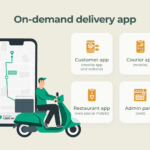
A successful courier app isn’t just about connecting customers to drivers. It requires a sophisticated multi-panel architecture that serves customers, delivery partners, and business owners simultaneously. Here are the essential feature categories you need to build in 2026.
A. Customer/User Panel Features
The customer-facing app is your primary revenue driver. Users need frictionless ordering, real-time visibility, and flexibility.
Essential Features:
Real-time GPS tracking – Customers see exactly where their package is, with live map updates and accurate ETA predictions
Multiple address storage – Save home, office, and other locations for quick reordering
Flexible delivery scheduling – Choose same-day, scheduled delivery, or recurring deliveries for subscriptions
Multiple payment options – Credit/debit cards, UPI, digital wallets, and cash-on-delivery
Automated notifications – SMS and push alerts at each stage (confirmed, picked up, out for delivery, delivered)
Order customization – Add special delivery instructions (fragile items, leave at door, specific time windows)
Ratings & review system – Build trust and help users choose reliable couriers based on ratings
Delivery history & saved orders – Quick reorder functionality for frequent shipments
B. Courier/Driver Panel Features
Your delivery partners need tools that maximize their efficiency and earnings. A poorly designed driver app leads to churn and poor service quality.
Essential Features:
AI-powered route optimization – Instead of manual dispatch, AI automatically calculates the most efficient delivery sequence, reducing fuel costs and delivery time
Real-time job assignments – Get notifications for nearby delivery requests with order details
Navigation integration – Turn-by-turn directions with traffic updates and real-time rerouting for obstacles
Digital proof of delivery (POD) – OTP verification, photo capture, or e-signature to confirm delivery
Earnings dashboard – Real-time income tracking, completed deliveries, and payout records
In-app communication – Chat and call customers without exposing phone numbers
Performance ratings – Clear visibility into customer ratings and performance metrics
Vehicle tracking integration – Monitor fuel, mileage, and maintenance alerts
C. Admin/Business Management Panel
Your operations team needs full visibility and control over the delivery network.
Essential Features:
Real-time order & fleet management – Monitor all active deliveries, track driver locations, and reassign orders if needed
AI-powered analytics dashboard – Key metrics including delivery success rate, average delivery time, cost per delivery, and customer satisfaction scores
Automated commission & payouts – Calculate and process driver commissions automatically without manual intervention
Customer support integration – Ticketing system for complaints, inquiries, and dispute resolution
Revenue and performance reports – Detailed analytics on revenue by geography, delivery time windows, and customer segments
Heatmap analysis – Identify high-demand areas and peak delivery times to optimize resource allocation
Driver and vehicle management – Onboard new couriers, track documents, manage vehicle capacity, and monitor compliance
D. Advanced Features (2026 Market Expectations)
To stay competitive, modern courier apps require intelligent systems that older platforms lack.
AI & Machine Learning:
Predictive ETA accuracy – Machine learning improves ETA accuracy by analyzing historical data, traffic patterns, and weather. This builds customer trust and reduces support inquiries
Demand forecasting – Predict delivery volume by geography and time to optimize courier availability
Smart carrier allocation – AI automatically assigns shipments to the best-suited courier based on location, capacity, and past performance
NLP-powered sentiment analysis – Automatically analyze customer reviews to detect service issues and flag couriers needing training
Emerging Technologies:
IoT-enabled tracking – Smart sensors monitor package condition (temperature, humidity, impacts) for fragile or perishable goods
Blockchain for transparency – Immutable delivery records and smart contracts for transparent, automated payments between platform and couriers
Voice-enabled ordering – Allow customers to place orders via voice commands for accessibility
Autonomous/drone integration – Infrastructure to support pilot programs for autonomous vehicle or drone deliveries in specific zones
Sustainability Features:
Eco-routing algorithms – Calculate routes that minimize carbon emissions, not just distance
Carbon footprint tracking – Show customers how much CO2 their delivery generated
Green delivery options – Offer eco-conscious customers slower (but greener) delivery alternatives at lower cost
EV integration – Support for electric vehicles with charging station mapping
User Engagement:
Gamification – Reward customers with points, badges, and leaderboards for sustainable choices or referrals
Loyalty rewards program – Points system where users earn discounts on future deliveries
Referral incentives – Both referrer and new user receive credits for successful signups
Feature Priority for MVP vs. Full Release
Build for MVP (Minimum Viable Product – 3-4 months):
Real-time GPS tracking
Multiple address storage
Simple payment integration (1-2 methods)
Basic delivery scheduling
Digital POD (OTP or photo)
Driver app with basic navigation
Admin dashboard with basic orders view
Automated SMS notifications
Add in Version 2.0 (Months 6-9):
AI route optimization
Multiple payment gateways (5+ options)
Loyalty program
Advanced analytics dashboard
In-app communication
Ratings & review system
Add in Version 3.0+ (Months 12+):
Predictive ETA using ML
NLP sentiment analysis
IoT tracking integration
Blockchain transparency
Drone/autonomous delivery infrastructure
Carbon footprint tracking
Voice-enabled ordering
Why These Features Matter
Each feature directly impacts either cost reduction, customer satisfaction, or competitive differentiation. Real-time tracking reduces “where is my package?” support calls. Route optimization cuts delivery costs by 15-20%. Predictive ETAs improve on-time delivery rates. AI carrier allocation ensures you’re using your fleet efficiently.
In 2026, customers expect most of these features as baseline. The platforms that gain market share are those that implement them efficiently—not the ones that add every feature possible, but the ones that execute the essential features exceptionally well.
COURIER APP BUSINESS MODELS
5 Proven Courier App Business Models for 2026
| Model | How It Works | Best For | Revenue Stream |
|---|---|---|---|
| Point-to-Point Delivery | Users send packages from location A to B; platform matches with couriers | Personal senders, small businesses | Commission per delivery (15-25%) |
| E-Commerce Integration | White-label delivery integrated into online stores; tracks warehouse to customer | Online retailers, D2C brands, marketplaces | Subscription + commission per delivery |
| Hyperlocal Marketplace | Users post requests; nearby couriers accept and bid | Densely populated urban areas | Service fee (10-20% per transaction) |
| B2B Fleet Management | On-demand courier assignment for logistics companies and enterprises | Courier companies, logistics firms | Monthly SaaS fee + per-delivery charges |
| Multi-Service Super App | Delivery + food + groceries + shopping + errands in 1-2 hours | Urban markets with high order frequency | Commission + subscription hybrid |
Point-to-Point → Best if you want simple mechanics and quick entry. Competitive but easiest to launch.
E-Commerce Integration → Best if targeting online businesses. Recurring revenue through subscriptions. Higher margins than pure commission.
Hyperlocal Marketplace → Best for building network effects quickly. Scale through viral growth in dense areas.
B2B Fleet Management → Best for enterprise revenue. Higher contract values, longer sales cycles, but more stable revenue.
Multi-Service Super App → Best if you have capital and user base. Requires critical mass in each category to work.
Revenue Model Breakdown
Most successful 2026 platforms use hybrid revenue models:
Commission per delivery: 12-25% depending on average order value
Subscription for premium features: $5-50/month for unlimited priority pickups, faster payouts, better analytics
Advertising: Display local business ads to customers
Data & analytics: Sell aggregated, anonymized delivery insights to businesses
White-label licensing: License your platform to other companies for their branded app
COST & DEVELOPMENT TIMELINE
Courier App Development Cost Breakdown
| Scope | Budget | Timeline | What’s Included |
|---|---|---|---|
| MVP (Minimum Viable Product) | $20K – $40K | 3-4 months | Single platform (iOS or Android), basic features, essential panels |
| Full-Scale App | $100K – $200K | 6-9 months | iOS + Android, all core features, admin dashboard, analytics |
| Enterprise Solution | $300K – $500K+ | 12+ months | Advanced AI, multiple integrations, scalable infrastructure, custom features |
Platform choice: Native development (iOS/Android separately) costs 30-40% more than cross-platform (React Native/Flutter)
Geographic scope: Single city vs. multi-state/country affects server infrastructure and compliance requirements
Feature complexity: AI route optimization, predictive analytics, and real-time tracking increase costs significantly
Third-party integrations: Google Maps, payment gateways, SMS providers add 10-15% to budget
Team location: Offshore development (India, Eastern Europe) costs 40-60% less than onshore (US, Western Europe)
Post-launch support: Budget 15-20% annually for maintenance, bug fixes, and feature updates
Development Timeline Breakdown
Discovery & Planning (2-4 weeks)
Market research, competitor analysis, requirement documentation, wireframing
UI/UX Design (3-4 weeks)
Mockups, user flows, design system, usability testing, design handoff
Backend Development (6-10 weeks)
API architecture, database design, authentication, payment integration, real-time systems
Frontend Development (6-10 weeks)
Mobile app development, web dashboard, admin panel, testing
QA & Testing (2-4 weeks)
Functional testing, performance testing, security audit, bug fixes
Launch & Optimization (1-2 weeks)
App Store submission, beta testing, performance monitoring, post-launch updates
Cost-Saving Tips for 2026
Start with MVP: Launch with 12-15 essential features, not 50. MVP costs 70% less and validates market fit faster
Use cross-platform frameworks: React Native or Flutter reduce development time by 30-40%
Pre-built solutions: Leverage existing APIs (Google Maps, Twilio SMS, Stripe payments) instead of building from scratch
Offshore development: Hire teams from India, Vietnam, or Eastern Europe for 40-60% cost savings without quality compromise
Agile development: Break project into 2-week sprints; prioritize ruthlessly to avoid scope creep
Open-source tools: Use open-source libraries for maps, real-time tracking, analytics instead of proprietary solutions
TECHNOLOGY STACK & ARCHITECTURE
Recommended Tech Stack for 2026
| Layer | Technology | Why |
|---|---|---|
| Frontend (Mobile) | React Native / Flutter | Build iOS + Android simultaneously; 30-40% faster development |
| Frontend (Web) | React / Vue.js | Fast, scalable, large community support |
| Backend | Node.js / Python / Go | High concurrency, real-time capabilities, easy to scale |
| Database | PostgreSQL + Redis | Relational data + in-memory caching for speed |
| Real-Time Communication | WebSockets / Socket.io | Live tracking, notifications, driver updates |
| Maps & Geolocation | Google Maps API / Mapbox | Proven, reliable routing and tracking |
| Authentication | JWT / OAuth 2.0 | Secure, scalable user authentication |
| Payment Gateway | Stripe / Razorpay / PayPal | Multiple payment options, PCI compliance |
| Cloud Infrastructure | AWS / Google Cloud / Azure | Auto-scaling, reliability, global reach |
| AI/ML Libraries | TensorFlow / scikit-learn / Python | Route optimization, demand forecasting, ETA prediction |
| Analytics | Mixpanel / Segment / Amplitude | User behavior tracking, funnel analysis |
| Push Notifications | Firebase Cloud Messaging | Real-time delivery updates to users |
Microservices vs. Monolithic
Start with monolithic: Simpler to deploy and manage initially
Migrate to microservices: As you scale beyond 1M deliveries/month, separate services for orders, payments, tracking, and driver management
Scalability Design
Load balancing: Distribute traffic across multiple servers to prevent bottlenecks
Database replication: Master-slave setup for redundancy and read scaling
CDN for media: Serve images, maps, and static assets from Content Delivery Network (faster globally)
Message queues: RabbitMQ or Kafka for handling spikes in delivery requests
Security & Compliance
Encryption: TLS for data in transit, AES-256 for sensitive data at rest
PCI DSS compliance: For payment processing
GDPR/data privacy: If operating internationally
Rate limiting & DDoS protection: Prevent abuse and attacks
Deployment & Infrastructure
Containerization: Docker for consistent environments across development, testing, and production
Orchestration: Kubernetes for managing containerized services at scale
CI/CD Pipeline: Automated testing and deployment on every code change (GitHub Actions, Jenkins)
Monitoring & Logging: New Relic, DataDog, or ELK Stack for monitoring performance and debugging issues
Backup & Recovery: Daily automated backups, disaster recovery plan with <1 hour RTO (Recovery Time Objective)
Why This Stack?
Speed to market: React Native gets you to both iOS and Android in 40% less time
Cost efficiency: Open-source tools and cloud auto-scaling reduce infrastructure costs
Team availability: JavaScript/Python are most widely known; easier to hire experienced developers
Proven at scale: Used by Uber, DoorDash, Glovo—companies handling millions of daily deliveries
Future-proof: All technologies have active development, large communities, and long-term support
STEP-BY-STEP DEVELOPMENT PROCESS
9 Phases to Launch Your Courier App
Phase 1: Ideation & Validation (Week 1-2)
Define your target market (geography, customer segment, delivery type)
Research competitors: Who are the top 5 players? What are their strengths/weaknesses?
Validate your unique value proposition: Why should customers choose you over Dunzo, Glovo, or Amazon Flex?
Interview 20-30 potential customers: Would they use your app? What would they pay?
Document findings and decide: Is there real demand? Can you execute better?
Phase 2: Business Model Design (Week 2-3)
Choose your business model: Point-to-point, e-commerce integration, hyperlocal marketplace, B2B, or super app
Define revenue streams: Commission per delivery, subscription, advertising, data licensing
Calculate unit economics: What’s your cost per delivery? How much commission do you need to be profitable?
Plan pricing strategy: How much will customers pay? How much will couriers earn?
Document financial projections for Year 1, Year 2, Year 3
Phase 3: Requirements & Wireframing (Week 3-5)
Create user stories: “As a [user type], I want [feature] so that [benefit]”
Build feature prioritization matrix: Must-have vs. Nice-to-have (focus on MVP)
Create wireframes for all key flows: Order placement, real-time tracking, driver assignment, payment
Define API specifications: What data flows between customer app, driver app, and admin panel?
Document technical requirements: Server capacity, database design, security protocols
Phase 4: Design & Prototyping (Week 5-9)
Create high-fidelity UI mockups for mobile and web
Build interactive prototype for user testing
Conduct usability testing with 5-10 target users; iterate based on feedback
Create design system (colors, typography, components) for consistency
Finalize all design specifications and hand off to development team
Phase 5: Backend Development (Week 9-19)
Set up cloud infrastructure (AWS/Google Cloud/Azure)
Design and build databases (PostgreSQL, Redis)
Develop APIs for customer, driver, and admin panels
Integrate third-party services (Google Maps, Stripe, SMS providers)
Build real-time tracking system (WebSockets for live location updates)
Implement authentication, authorization, and security protocols
Write unit tests and integration tests
Phase 6: Frontend Development (Week 9-19)
Develop iOS app (React Native or native Swift)
Develop Android app (React Native or native Kotlin)
Build web dashboard for admin panel
Integrate APIs with frontend
Implement offline functionality (app works without internet for basic features)
Write end-to-end tests
Optimize performance (app size, load time, battery usage)
Phase 7: Integration & QA Testing (Week 19-23)
Functional testing: Does every feature work as expected?
Performance testing: Can the system handle peak load? (10K concurrent users, 1K orders/minute)
Security testing: Penetration testing, vulnerability scanning
Compatibility testing: Works on all device types, OS versions, network conditions
User acceptance testing: Real users test MVP and provide feedback
Bug fixes and optimization
Phase 8: Launch & Store Submission (Week 23-25)
Prepare App Store and Google Play listings (screenshots, description, keywords)
Generate required assets (icons, splash screens, promotional images)
Submit apps to App Store and Google Play (1-2 week review process)
Set up customer support system (email, chat, helpdesk)
Prepare launch marketing: Social media, press release, influencer partnerships
Do soft launch in limited geography (test with 5K-10K users first)
Phase 9: Post-Launch Monitoring & Iteration (Week 25+)
Monitor app performance: Crashes, bugs, user feedback
Collect analytics: User acquisition, retention, churn, order volume
Fix critical bugs within 24 hours
Release weekly updates with small improvements
Gather user feedback through surveys and in-app reviews
Plan Version 2.0 features based on usage data
Scale gradually to new geographies based on learnings
Timeline Summary
| Phase | Duration | Key Output |
|---|---|---|
| Ideation & Validation | 2 weeks | Market validation, go/no-go decision |
| Business Model Design | 1 week | Revenue model, financial projections |
| Requirements & Wireframing | 2 weeks | Feature list, wireframes, API specs |
| Design & Prototyping | 4 weeks | Hi-fi mockups, prototype, design system |
| Backend Development | 10 weeks | APIs, databases, real-time systems, security |
| Frontend Development | 10 weeks | iOS app, Android app, web dashboard |
| Integration & QA | 4 weeks | Testing, bug fixes, optimization |
| Launch | 2 weeks | App Store submission, soft launch |
| Total | ~25 weeks (6 months) | Live MVP in market |
CHALLENGES & SOLUTIONS
Real Courier App Challenges & How to Solve Them
Challenge 1: Driver Shortage & High Churn
The Problem: Courier apps struggle to attract and retain drivers. High churn rates (40-60% monthly) mean constant recruitment costs and service quality issues.
Solutions:
Implement gamification: Leaderboards, badges, achievement levels to increase engagement
Dynamic surge pricing: Automatically increase rates during peak hours to incentivize availability
Loyalty rewards: Cumulative earnings bonuses (e.g., 5% bonus after 500 deliveries)
Transparent earnings: Show drivers real-time income and bonus potential before accepting jobs
Performance incentives: Offer bonuses for on-time deliveries, high ratings, and zero cancellations
Partner with logistics companies: Offer courier jobs as supplementary income to existing delivery staff
Invest in driver experience: Quality vehicle, fuel subsidies, insurance, accident coverage
Challenge 2: Last-Mile Economics
The Problem: Last-mile delivery costs can be 50-70% of total delivery cost. Many deliveries are unprofitable at standard pricing.
Solutions:
AI route optimization: Reduce delivery time per order by 20-30% through intelligent sequencing
Batch deliveries: Combine multiple orders going to same area into single trip
Consolidation hubs: Use neighborhood-level pickup points instead of direct home delivery
Flexible delivery windows: Offer discounts for off-peak delivery times (non-prime hours are cheaper)
Shared delivery services: Partner with other couriers/retailers to share delivery routes
Micro-fulfillment centers: Place small warehouses closer to customers to reduce delivery distance
Subscription model: Charge monthly fee for unlimited deliveries to spread fixed costs
Challenge 3: Customer Trust & Low Adoption
The Problem: New courier apps struggle with trust. Users stick with established brands (Amazon, Flipkart, Dunzo) due to reliability and brand recognition.
Solutions:
Real-time tracking: Live GPS updates reduce anxiety and “where is my package” support calls
Digital proof of delivery: Photo, OTP, or e-signature proves delivery happened
Transparent pricing: Show exact cost breakdown before confirming order
Money-back guarantee: Refund if delivery is late beyond promised window
User ratings & reviews: Publicly display courier ratings; allow users to choose highly-rated couriers
In-app communication: Direct chat with driver (without exposing phone numbers)
Insurance coverage: Offer optional package insurance for valuable items
Celebrity/influencer endorsement: Build credibility through trusted voices
Challenge 4: Payment Security & Fraud
The Problem: Payment failures, chargebacks, and fraud reduce profitability and user trust.
Solutions:
PCI DSS compliance: Ensure all payment data is encrypted and secure
Multiple payment gateways: Offer credit/debit, UPI, wallets, BNPL to reduce single-point failure
Fraud detection: Use machine learning to flag suspicious transaction patterns
Escrow system: Hold payment until delivery confirmed (protects both customer and courier)
Two-factor authentication: Require OTP for sensitive transactions
Clear refund policy: Be transparent about when and how refunds are processed
Dispute resolution: Clear process for customers to dispute payments with timeline
Challenge 5: Regulatory Compliance & Licensing
The Problem: Courier operations require local licenses, insurance, and tax compliance that vary by geography.
Solutions:
Hire local compliance team: Understand regulations in each city/state where you operate
Insurance partnerships: Partner with insurers for vehicle and liability coverage at scale
Legal documentation: Have clear contracts with couriers covering liability, compensation, dispute resolution
Data privacy compliance: Implement GDPR, CCPA, and India’s digital payment compliance
Tax automation: Use accounting software to automatically track GST, income tax, and other obligations
Government partnerships: Work with local authorities for licenses and permits
Start in single city: Master compliance in one market before expanding to others
Challenge 6: Churn & Customer Retention
The Problem: User acquisition is expensive ($3-10 per user). If users don’t make repeat orders, unit economics break.
Solutions:
Loyalty program: Reward points per order, redeemable for discounts or free deliveries
Personalized offers: Send targeted discounts based on user’s ordering history
Referral incentives: Give credits to users who refer friends ($2-5 per successful referral)
Subscription model: Monthly plans (unlimited free delivery) incentivize regular usage
Proactive customer support: Call/message users immediately if order is delayed
Value-adds: Free gift wrapping, greeting card, premium packaging
Gamification: Streak bonuses (e.g., 10% discount if you order every week for 4 weeks)
Community building: Create user groups, host contests, build sense of belonging
Challenge 7: Scalability & Infrastructure Bottlenecks
The Problem: Rapid growth causes system crashes, slow load times, and poor user experience.
Solutions:
Microservices architecture: Build independent services for orders, payments, tracking, driver assignment
Database optimization: Implement caching (Redis), read replicas, database partitioning
Load balancing: Distribute traffic across multiple servers to prevent single-point failure
Auto-scaling: Cloud infrastructure automatically spins up servers during peak load
CDN for media: Serve images and static content from geographically distributed servers
API rate limiting: Prevent abuse and manage server load
Performance monitoring: Use tools like DataDog, New Relic to identify and fix bottlenecks early
Stress testing: Regularly test system with 10x expected load to ensure stability
Challenge 8: Market Competition & Differentiation
The Problem: Glovo, Dunzo, Amazon Flex, and regional players have massive scale and funding. Hard to compete directly.
Solutions:
Vertical specialization: Focus on specific verticals (medical deliveries, fragile goods, same-day packages)
Geographic focus: Dominate a single city/region before expanding (become #1 locally)
Superior service: Offer better courier ratings, faster delivery times, or 24/7 availability
Unique features: Implement advanced tech (AI routing, drone delivery, eco-friendly options) competitors lack
B2B focus: Target businesses (e-commerce stores, retailers) instead of competing with consumers
Partnership model: Partner with established retailers/marketplaces for white-label delivery
Price leadership: Undercut competitors on price until you reach scale (requires deep pockets)
Community approach: Build loyal base through excellent support, transparent pricing, community engagement
Challenge 9: Real-Time Tracking Accuracy
The Problem: GPS tracking fails in urban canyons, tunnels, and dense areas. Inaccurate ETAs frustrate customers.
Solutions:
Multiple signal sources: Combine GPS, WiFi triangulation, cell tower data for accuracy
Machine learning ETAs: Train models on historical delivery data to predict accurate arrival times
Buffer times: Always add 5-10 minute buffer to ETA to avoid overshouting expectations
Manual driver updates: Allow drivers to update status if GPS fails
Offline functionality: App works without GPS for basic features
User communication: Proactively notify customers if delay is expected
Fallback systems: Have backup tracking methods if primary system fails
Regular map updates: Keep Google Maps integration current with latest road data
Challenge 10: Unit Economics & Profitability
The Problem: Many courier apps burn cash; commission rates are too low, delivery costs are too high.
Solutions:
Clear metrics tracking: Monitor cost per delivery, commission rate, customer acquisition cost (CAC) daily
Dynamic pricing: Adjust rates based on demand, distance, urgency, package weight
Bulk discounts: Offer lower rates to high-volume business customers
Value-added services: Premium delivery (2-hour window), insurance, gift wrapping for higher margins
Reduce operational costs: Automate customer support with chatbots, use AI for dispatch
Supply-side revenue: Charge drivers subscription fees for app access, premium features, analytics
B2B focus: Business customers have higher AOV (average order value) and repeat frequency
Data monetization: Sell anonymized delivery insights to businesses, retailers (be transparent about privacy)
Focus on retention: Keeping existing customers is cheaper than acquiring new ones
Implementation Priority
Solve immediately (Months 1-3):
Driver churn mitigation
Payment security & fraud prevention
Regulatory compliance
Solve in first year:
Customer trust & adoption
Last-mile economics
Scalability issues
Optimize ongoing:
Retention & engagement
Competition & differentiation
Unit economics
2026 TRENDS & FUTURE ROADMAP
Key Trends Shaping Courier Apps in 2026
Trend 1: AI-Powered Logistics Becomes Standard
AI route optimization is reducing delivery costs by 15-20%. By 2026, this is baseline—not a competitive advantage.
Predictive ETAs: ML models predict arrival times with 95% accuracy, reducing customer support calls
Demand forecasting: AI predicts delivery volume by geography and time, enabling pre-positioning of drivers
Intelligent carrier allocation: Automatic assignment of shipments to best-suited couriers
Sentiment analysis: NLP identifies service issues from customer reviews
Trend 2: Autonomous & Drone Deliveries
Autonomous vehicles and drones are moving from pilot to mainstream in 2026. Your app needs infrastructure to support multiple vehicle types.
Amazon and Google operating drone delivery pilots in multiple US cities
20-30% cost reduction vs. human delivery by 2028
Apps need to route orders intelligently (humans for complex, drones for simple, autonomous for bulk)
Monitor local regulations; plan partnerships with autonomous providers
Trend 3: Sustainability & Green Delivery
35-40% of urban consumers prefer eco-friendly delivery options. This is becoming competitive differentiator.
EV integration: Optimize routes for charging stations and battery limits
Carbon tracking: Display CO2 footprint per delivery
Eco-routing: Calculate lowest-carbon routes, not just fastest
Green delivery option: Offer slower but cheaper eco-delivery to environmentally conscious users
Trend 4: Subscription-Based Delivery
Recurring revenue models are replacing pay-per-delivery.
Unlimited delivery subscriptions ($5-20/month) similar to Amazon Prime
Tiered memberships: Basic, Premium, VIP with increasing benefits
Increases customer lifetime value and order frequency
Launch at 10K-20K monthly active users
Trend 5: Voice-Enabled & Conversational Ordering
Voice commands are now standard for app interaction.
“Order a same-day delivery to [address]” becomes norm
Chatbots handle 80% of customer inquiries
Critical for accessibility and emerging market adoption
Integrate Google Assistant API or Alexa Skills Kit
Trend 6: Hyperlocal & Micro-Fulfillment
Same-day delivery expectations require new infrastructure—neighborhood-level fulfillment centers instead of city-wide warehouses.
Delivery distance reduces from 10-15km to 1-3km
Lower costs, faster fulfillment, higher profitability
Start in 1-2 high-density neighborhoods, expand gradually
Partner with retailers for co-location opportunities
Trend 7: Super Apps Dominating
Standalone delivery apps are struggling. Winners integrate delivery into broader platforms (Glovo, Swiggy, Grab).
Delivery + food + groceries + shopping in one app
10x higher user engagement vs. standalone apps
For new entrants: Either build super app or specialize in vertical (e-pharmacy, fragile goods, B2B)
Trend 8: Data Monetization
Courier platforms monetizing aggregated, anonymized delivery data to retailers, real estate companies, and cities.
Hyperlocal demand insights
Consumer behavior analytics
Premium subscribers pay $500-5000/month
Important: Be transparent about data collection; comply with GDPR, CCPA, India privacy rules
2026-2030 Development Roadmap
| Year | Focus | Key Features |
|---|---|---|
| 2026 | MVP Launch | Real-time tracking, AI routing, payments, loyalty, basic analytics |
| 2027 | Growth | Autonomous readiness, sustainability, voice ordering, B2B APIs |
| 2028 | Scale | Drone pilots, super app integration, subscriptions, micro-fulfillment |
| 2029-30 | Consolidation | Market dominance, profitability, M&A/IPO readiness |
CASE STUDIES
Real-World Courier App Success Stories
Case Study 1: Amazon Flex – Crowdsourced Logistics at Scale
Problem:
Amazon faced last-mile delivery bottlenecks during peak seasons. Building a massive company-owned delivery fleet was capital-intensive and inflexible. They needed to scale delivery capacity without massive fixed costs.
Solution:
Amazon created Amazon Flex—an app allowing independent contractors with personal vehicles to deliver packages on their own schedule. The platform uses AI to optimize delivery routes, dynamically adjusts delivery blocks based on demand, and offers variable pay rates during peak hours. Drivers see real-time earnings and can choose which deliveries to accept.
Results:
Scaled to 300K+ active Flex drivers across US by 2025
Reduced last-mile delivery costs by 30-40% vs. traditional logistics
Enabled same-day and next-day delivery at Amazon scale
Generated $2+ billion in delivery capacity without owning vehicles
Key Lesson:
Network effects + flexible supply side (drivers) + technology (AI routing) = massive scalability without massive capital investment.
Case Study 2: Glovo – Hyperlocal Super App Domination
Problem:
European cities had fragmented delivery services—separate apps for food, groceries, shopping, errands. No unified platform existed to consolidate quick commerce across categories.
Solution:
Glovo built a super app combining delivery across food, groceries, shopping, restaurants, and errands. They used hyper-local network effects—the more users in a neighborhood, the more attractive it becomes for merchants and couriers. AI route optimization enabled 30-minute delivery windows at scale. Strategic acquisitions and partnerships accelerated market dominance in each city.
Results:
Operating in 400+ cities across 50+ countries
15M+ monthly active users (2024)
Profitability achieved in mature markets
Valuation: $3.6 billion (Series F funding round)
Market leader in Spain, Portugal, parts of Latin America
Key Lesson:
Super app model captures higher user lifetime value. Hyperlocal focus (dominating neighborhoods before expanding cities) builds defensible moat.
Case Study 3: DHL Express – Enterprise AI Integration
Problem:
DHL, a 50+ year-old logistics giant, faced disruption from tech-native competitors like Glovo and Amazon. Manual dispatch, paper-based POD, and siloed systems made them slow and expensive.
Solution:
DHL digitized operations with AI-powered route optimization, real-time tracking, and mobile app for both customers and couriers. They integrated IoT sensors for high-value shipments, implemented blockchain for pharmaceutical supply chain transparency, and launched same-day delivery service in major cities. Focused on B2B/enterprise customers willing to pay premium for reliability.
Results:
Reduced delivery costs by 20% through AI optimization
Same-day delivery now available in 50+ cities
Enterprise customers (pharma, tech, luxury goods) expanded by 40%
Blockchain pilots reduced fraud in high-value deliveries
Maintained #2 global market position against digital natives
Key Lesson:
Established companies can compete with tech startups by leveraging existing infrastructure + digital transformation. B2B/enterprise focus provides higher margins and stickier customers than consumer market.
Case Study 4: Dunzo – Quick Commerce Leader (India)
Problem:
India’s urban consumers wanted same-day delivery for everything (groceries, medicines, documents, packages)—but no unified platform existed. Multiple app downloads for each category frustrated users.
Solution:
Dunzo built a hyperlocal super app for 30-minute delivery across categories. They used dense courier networks in tier-1 cities, gamified the driver experience with leaderboards and earnings bonuses, and optimized unit economics through high order frequency. B2B partnerships with retailers and restaurants reduced customer acquisition cost.
Results:
2M+ daily deliveries across major Indian cities
Active in 12 cities with plans for expansion
Raised $100M+ in funding
Achieved profitability in mature markets
4.8-star rating across 500K+ reviews
Key Lesson:
In emerging markets with price-sensitive consumers, unit economics and operational efficiency (not premium features) win. Volume + frequency = profitability.
What These Case Studies Teach You
| Company | Key Success Factor | Lesson for Your App |
|---|---|---|
| Amazon Flex | Crowdsourced supply, AI optimization | Don’t own delivery fleet; incentivize independent couriers |
| Glovo | Super app + hyperlocal network effects | Expand across categories; dominate neighborhoods before cities |
| DHL Express | Digital transformation of legacy player | B2B focus = higher margins + sticky customers |
| Dunzo | Unit economics + high frequency | In price-sensitive markets, volume and efficiency beat features |
IMPLEMENTATION CHECKLIST
Your Courier App Development Roadmap
Use this checklist to track progress from ideation through launch and beyond.
Pre-Development (Weeks 1-5)
Market & Business
Validate demand with 20-30 customer interviews
Analyze top 5 competitors and identify your advantage
Define business model and revenue streams
Calculate unit economics (cost per delivery, required commission)
Create 3-year financial projections
Product & Tech
Document 12-15 MVP features (not 50+)
Create wireframes for key user flows
Select tech stack (React Native, Node.js, PostgreSQL)
Define success metrics (DAU, orders/day, ratings)
Legal
Register business and obtain licenses
Consult lawyer on courier regulations
Draft customer terms and driver agreements
Plan data privacy compliance
Development (Weeks 5-25)
Backend
Build user authentication and order management APIs
Integrate payment gateway (Stripe/Razorpay/PayPal)
Build real-time tracking system
Set up notifications (SMS, push, email)
Build admin dashboard APIs
Frontend (Mobile)
Build customer app (iOS + Android with React Native)
Build driver app (iOS + Android)
Integrate Google Maps for tracking
Optimize performance (app size, load time)
Frontend (Web)
Build admin dashboard
Build customer web portal
Test responsive design
Testing & QA
Unit tests (80%+ backend coverage)
Functional testing of all features
Performance testing under peak load
Security and penetration testing
Device/OS compatibility testing
Launch (Weeks 23-25)
Submit iOS app to Apple App Store
Submit Android app to Google Play Store
Configure monitoring and alerts
Set up customer support system
Soft launch in single neighborhood (5K-10K users)
Fix critical bugs within 24 hours
Post-Launch (Weeks 25+)
Monitoring
Track daily metrics (DAU, orders, ratings)
Monitor customer acquisition cost and payback period
Track delivery success rate and customer satisfaction
Fix bugs and optimize performance weekly
Growth
Launch loyalty program
Run referral program
Implement surge pricing during peak hours
Plan expansion to 2nd city
A/B test UI, pricing, incentives
Compliance
Data privacy audit
Update insurance coverage
Maintain tax compliance (GST, payroll)
Keep regulatory compliance current
Key Success Metrics to Monitor
Customer:
Daily/Monthly Active Users
Customer Acquisition Cost
Orders per user per month
Customer rating (target: 4.5+ stars)
Courier:
Active couriers
Deliveries per courier per day
On-time delivery rate (target: 95%+)
Courier rating (target: 4.7+ stars)
Business:
Daily orders
Gross margin (target: 30-40%)
Unit economics (CAC payback <3 months)
App store rating (target: 4.3+)
The Courier App Opportunity of 2026
The global courier delivery market is expanding at 9.8%-14.2% CAGR through 2035. Consumer expectations have shifted permanently—same-day delivery is now baseline, real-time tracking is non-negotiable, and sustainability matters. Technology has matured enough to be accessible to startups. The conditions for building a successful courier app have never been better.
But opportunity without execution is worthless.
The founders who will capture disproportionate value in 2026 aren’t those building the most features. They’re the ones who:
Obsess over unit economics — knowing exactly how much each delivery costs and how to make it profitable at scale
Start hyperlocal — dominating a single neighborhood or city before expanding, building defensible network effects
Execute relentlessly — shipping MVPs in 4-6 months, not planning for 2 years before launching
Listen to markets — adapting based on real customer and courier feedback, not building what they think users want
Leverage technology strategically — using AI for route optimization and demand forecasting, not building everything from scratch
The blueprint exists. You now have the strategy, the feature roadmap, the business models, the technology stack, the development process, and the real-world case studies of what works.
The only remaining variable is execution.
Start this week with market validation. Interview potential customers. Analyze competitors. Calculate your unit economics. Assemble your team. Then build.
The courier app winners of 2026 aren’t the smartest or the best-funded—they’re the ones who start now and iterate relentlessly.
Will you be one of them?
This comprehensive guide was prepared by Read Authentic, a global platform providing verified, research-backed insights for business and tech leaders navigating digital transformation, AI, software development, and growth strategy.
For more insights on app development, digital strategy, and building scalable businesses, visit Read Authentic and subscribe to stay updated on 2026 trends and opportunities.
-
How much does it cost to build a courier app?
MVP costs $20K-$40K (3-4 months), full-scale $100K-$200K (6-9 months), enterprise $300K-$500K+ (12+ months). Cost depends on features, platforms, and team location.
-
How long does it take to develop a courier app?
4-6 months for MVP, 6-9 months for full-scale app. Timeline includes design, development, testing, and launch.
-
What features are essential for a courier app?
Real-time GPS tracking, multiple payment options, driver app with route optimization, admin dashboard, digital proof of delivery, ratings & reviews, and automated notifications.
-
Which business model is best for a courier app?
Point-to-point is easiest to launch. Hyperlocal marketplace scales fastest. E-commerce integration provides steady revenue. B2B has highest margins.
-
What technology should I use?
React Native/Flutter (mobile), Node.js/Python (backend), PostgreSQL+Redis (database), Google Maps API, AWS/Google Cloud. This stack handles millions of deliveries.
-
Is it hard to build a successful courier app?
Main challenges are driver retention, last-mile economics, and competition. Success requires strong unit economics and operational efficiency.
Research and Written by Read Authentic Team
Edited By: Read Authentic & Team
Expert Reviewed By: Mukesh Ram
Fact Checked By: Zubair Pateljiwala
Copy Edited By: Nayan Mistry