
Quick Answer
AI development is the process of designing, building, training, and deploying artificial intelligence systems — including machine learning models, neural networks, NLP tools, and generative AI applications — to solve real business problems. It combines software engineering, data science, and model training into a specialized development discipline.
AI Development:
If you strip away all the technical language, AI development is simply the work of building software that can learn from data and make decisions on its own. Instead of a programmer writing a rule for every possible situation, the system figures out patterns by itself after being shown enough examples.
That is the core idea. Everything else, the frameworks, the cloud platforms, the model types, builds on top of that basic concept.
What This Guide Covers
This guide walks you through the full picture of AI development in 2026. You will find the definition, the six main types, the step-by-step development process, the tools and tech stack most teams use, real-world use cases, cost expectations, and practical advice on how to get started. No assumed knowledge required.
What Is AI Development? (Full Definition)
AI development refers to the end-to-end process of creating software systems that use artificial intelligence to perform tasks that would traditionally require human judgment. This covers everything from defining the problem to writing the code, training the model on data, testing it, integrating it into a product, and keeping it updated once it is live.
The reason it is considered a separate discipline from regular software development is that the output is not just a program following fixed instructions. The output is a system that learns and adapts. That changes how you plan for it, how you build it, and how you measure whether it is working.
In 2026, AI development touches almost every industry. Teams use it to build chatbots, recommendation engines, fraud detection systems, diagnostic tools, content generators, and much more. The scale and speed of adoption has grown significantly in the past two years alone, driven largely by the availability of powerful pre-trained models and accessible cloud infrastructure.
AI Development vs Traditional Software Development
In traditional software development, a developer writes explicit logic. If a user does X, the system does Y. The behavior is predictable and fixed. You can read the code and trace exactly why the system responds the way it does.
AI development works differently. You do not write the rules. You give the system data and a learning objective, and it builds its own internal representation of the rules through training. This means the developer’s job shifts from writing logic to curating data, choosing the right model architecture, and evaluating whether the model has learned what you intended.
Both approaches are valid and often used together inside the same product. The skill is knowing when to use which one.
AI Development vs Machine Learning vs Data Science
These three terms get used interchangeably online, but they are not the same thing. Data science is focused on analyzing data to find insights. Machine learning is a method of building systems that learn from data. AI development is the broader engineering discipline that may use machine learning as one of its tools, but also includes building the product infrastructure, APIs, interfaces, and deployment pipelines around the model.
Think of it this way: a data scientist finds patterns in data. A machine learning engineer builds a model that learns those patterns automatically. An AI developer builds the full system that puts that model into the hands of users.
Types of AI Development
AI development is not one thing. There are six distinct tracks, each with its own methods, tools, and use cases. Most real products combine two or more of these.
1. Machine Learning Development
Machine learning development involves training algorithms on structured or semi-structured data so they can make predictions or decisions. Common examples include credit scoring models, product recommendation engines, and churn prediction tools. This is the most mature area of AI development and the foundation most other types build on.
2. Deep Learning Development
Deep learning uses large neural networks with many layers to process complex inputs like images, audio, and long text. It requires significantly more data and computing power than standard machine learning, but it unlocks capabilities that simpler models cannot match, like recognizing objects in photos or transcribing speech with high accuracy.
3. Natural Language Processing (NLP)
NLP development focuses on building systems that understand and generate human language. This includes chatbots, search engines, document summarization tools, sentiment analysis, and language translation. NLP has advanced enormously in the past few years, largely due to the rise of large language models.
4. Computer Vision Development
Computer vision systems process and interpret visual data. They are used in security cameras that detect intruders, medical imaging tools that flag abnormalities, manufacturing lines that catch defects, and autonomous vehicles that navigate roads. Building these systems requires specialized model architectures and large labeled image datasets.
5. Generative AI Development
Generative AI refers to systems that create new content rather than just classify or predict. This includes text generators, image generators, code assistants, and audio synthesis tools. In 2026, this is one of the fastest-moving areas in the field, with new model releases and application frameworks emerging on a near-monthly basis. For a deeper look, see our guide on generative AI development.
6. Agentic AI Development (New in 2026)
Agentic AI is one of the most significant developments of the past year. These are AI systems that can take sequences of actions autonomously, using tools, browsing the web, writing and running code, and completing multi-step tasks without human hand-holding at each stage. Building agentic systems requires orchestration frameworks, careful tool design, and robust safety checks. This is where a large share of enterprise AI investment is currently flowing.
How AI Development Works: Step by Step
There is a repeatable process that professional AI development teams follow. It is not always linear, and you will often loop back to earlier steps as you learn more, but understanding the stages helps you plan realistically.
Step 1: Problem Definition and Use Case Scoping
Before writing a single line of code, a skilled team spends time understanding the actual business problem. What decision needs to be made? What does success look like? What data exists, and what data would need to be collected? Rushing past this step is the single most common reason AI projects fail.
Step 2: Data Collection and Preparation
AI systems learn from data, so the quality and quantity of your training data directly determines how well your model performs. This step involves identifying sources, collecting samples, cleaning messy records, labeling examples, and structuring the data so a model can learn from it. In most projects, this takes more time than the actual model training.
Step 3: Model Selection (API vs Custom Training)
You have two broad options. You can use a pre-trained model through an API, such as calling a large language model to handle text understanding, which is faster and cheaper. Or you can train a custom model from scratch on your own data, which gives you more control and better performance on domain-specific tasks. Most teams in 2026 start with an API approach and move to custom training only when they hit a ceiling.
Step 4: Model Training and Evaluation
If you are training a custom model, this step involves running the training process on your prepared dataset, then evaluating the results against a held-out test set. You measure performance using metrics relevant to your task, such as accuracy, precision, recall, or BLEU score for language tasks. You then adjust the model architecture, training parameters, or data mix and retrain until performance meets your benchmark.
Step 5: Integration and API Layer Development
A model that works in a notebook is not a product. This step covers wrapping the model in an API, connecting it to your application, handling edge cases, writing error handling, and making sure the system behaves correctly across different inputs. This is where traditional software engineering skills become critical.
Step 6: Deployment to Production
Deploying an AI model involves choices about where it runs, such as a cloud provider, on-premise server, or edge device, and how it scales to handle real traffic. You also need to set up monitoring so you can catch problems early. This step often includes containerizing the model, setting up CI/CD pipelines, and configuring auto-scaling infrastructure.
Step 7: Monitoring, Feedback, and Retraining
AI models degrade over time as the real world changes and user behavior shifts. Monitoring for data drift, tracking model performance in production, collecting user feedback, and periodically retraining on new data are not optional extras. They are core parts of keeping an AI system working well. Teams that skip this step often find their models quietly getting worse for months before anyone notices.
AI Development Tech Stack in 2026
The tools used in AI development have stabilized considerably compared to a few years ago. Here is a practical breakdown of what most professional teams are using today.
Languages: Python, R, and Julia
Python dominates AI development by a wide margin. Its ecosystem of libraries, the availability of tutorials and community support, and its readability make it the default choice for nearly every team. R is still used in academic and statistical contexts. Julia is gaining traction for high-performance numerical computing but remains a niche choice.
Frameworks: TensorFlow, PyTorch, and LangChain
PyTorch has become the preferred framework for research and most new production projects, valued for its flexibility and clean debugging experience. TensorFlow remains widely deployed in enterprise systems that were built a few years ago. LangChain and similar orchestration frameworks have become essential for teams building LLM-powered applications, managing prompt chains, memory, tool use, and API calls.
Cloud Platforms: AWS, GCP, and Azure AI
All three major cloud providers offer managed AI infrastructure. AWS SageMaker, Google Vertex AI, and Azure Machine Learning provide environments for training, evaluating, and deploying models without managing raw server infrastructure. The right choice usually depends on what cloud your organization already uses.
Vector Databases: Pinecone, Weaviate, and Qdrant
Vector databases have become a standard part of the AI stack, particularly for applications that use retrieval-augmented generation. They store and search high-dimensional embeddings efficiently, allowing you to build systems that retrieve relevant documents or data points quickly before passing them to a language model.
AI Development Tech Stack at a Glance
Layer | Tool / Technology | Primary Use Case |
Language | Python | General AI and ML development |
Deep Learning Framework | PyTorch | Model training and research |
Deep Learning Framework | TensorFlow | Enterprise production deployments |
LLM Orchestration | LangChain / LlamaIndex | Building LLM-powered apps |
Cloud AI Platform | AWS SageMaker | Managed ML training and deployment |
Cloud AI Platform | Google Vertex AI | Integrated ML pipeline management |
Cloud AI Platform | Azure Machine Learning | Enterprise AI on Microsoft stack |
Vector Database | Pinecone | Embedding search for RAG apps |
Vector Database | Weaviate | Open-source vector search |
Vector Database | Qdrant | High-performance vector filtering |
Model Serving | FastAPI + Docker | Wrapping models in production APIs |
Experiment Tracking | MLflow / Weights & Biases | Logging training runs and metrics |
Who Is an AI Developer? Role, Skills, and Salary in 2026
An AI developer is someone who designs and builds AI-powered systems. The role blends skills from software engineering, data science, and machine learning. In practice, different team members specialize in different parts of the stack, and larger teams often separate out roles like ML engineer, data engineer, AI product manager, and AI researcher.
Core skills most AI developers are expected to have include proficiency in Python, a solid grasp of statistics and probability, experience with at least one major ML framework, the ability to work with large datasets, and familiarity with cloud deployment. Increasingly, familiarity with prompting large language models and building agentic workflows is also expected.
Salary ranges in 2026 vary by specialization and location, but experienced AI engineers in the United States typically earn between $150,000 and $250,000 annually in full-time roles. Freelance and agency rates for AI development projects span a wide range depending on the complexity and duration of the work.
Real-World Use Cases by Industry
AI development is producing measurable results across a broad range of sectors. Here is a snapshot of where it is being applied most actively right now.
Healthcare: AI systems are being used to analyze medical images for early cancer detection, predict patient readmission risk, accelerate drug discovery pipelines, and support clinical decision-making with evidence-based suggestions.
Finance: Banks and fintech companies use AI for real-time fraud detection, credit risk assessment, algorithmic trading, customer service automation, and compliance monitoring. These applications handle enormous transaction volumes that no human team could review manually.
E-commerce: Product recommendation engines, dynamic pricing systems, visual search tools, and AI-written product descriptions are now standard infrastructure for large online retailers. Smaller retailers are accessing similar capabilities through third-party AI platforms.
Human Resources: AI tools assist with resume screening, candidate matching, interview scheduling, employee sentiment analysis, and workforce planning. This area comes with significant ethical considerations around bias, and responsible teams invest heavily in fairness testing.
Customer Support: AI-powered chatbots and voice agents handle a growing share of tier-one support interactions, resolving common issues without human involvement. The best implementations combine AI for speed with human handoff for complexity.
How Much Does AI Development Cost? (Overview)
Cost varies enormously depending on the type of AI system, the size of the team, the data requirements, and the deployment environment. A simple chatbot built on top of an existing LLM API can be prototyped for a few thousand dollars. A custom-trained computer vision system for industrial use might cost hundreds of thousands before it reaches production.
Common cost drivers include data labeling, compute for training, engineering salaries, cloud infrastructure, and ongoing monitoring and retraining. The hidden costs of AI projects, particularly data preparation and post-deployment maintenance, are frequently underestimated.
For a detailed breakdown with current figures, see our full AI development cost guide for 2026.
How to Get Started with AI Development in 2026
If you are looking to bring AI into your organization or career, there are three realistic paths depending on your resources and goals.
Option 1: Build In-House. If you have the budget and a long-term commitment to AI, hiring an internal team gives you the most control and the deepest institutional knowledge over time. This path works best for companies where AI is a core competitive advantage rather than a supporting function.
Option 2: Work with an Agency. For most companies, especially those tackling their first AI project, working with a specialized AI development agency is the fastest and most cost-effective route. You get access to experienced teams without the overhead of hiring. See our guide to the best AI development companies to understand what to look for.
Option 3: Use No-Code and Low-Code Tools. Platforms like Vertex AI AutoML, Microsoft Azure AI Studio, and several newer entrants allow teams to build and deploy AI capabilities without deep technical expertise. This is a sensible starting point for smaller teams that want to validate a use case before committing to a larger build.
Final Thoughts
AI development is no longer the exclusive domain of research labs and tech giants. The tools have matured, the talent pool has grown, and the business case has been proven across enough industries that the question for most organizations is no longer whether to invest in AI, but how to do it well.
The fundamentals covered in this guide, the types, the process, the tech stack, and the cost factors, give you a solid foundation for making that decision with clarity. From here, the natural next step is understanding which type of AI development fits your specific problem, and what a realistic build looks like for your situation.
-
What is the difference between AI and ML development?
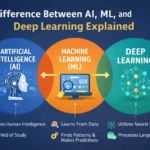
Machine learning is a subset of AI. ML development specifically refers to building systems that learn from data using statistical models. AI development is the broader practice that includes ML but also covers rules-based systems, computer vision, NLP, generative AI, and agentic systems. All ML is AI development, but not all AI development involves machine learning.
-
How long does AI development take?
A simple prototype using an existing API can be built in days to weeks. A production-ready custom model with proper data pipelines, evaluation, deployment, and monitoring typically takes three to nine months for a focused team. Enterprise-scale systems with compliance requirements can take longer. Scope and data readiness are the biggest variables.
-
What programming language is used for AI development?
Python is the dominant language in AI development by a significant margin. Its libraries, including NumPy, Pandas, Scikit-learn, PyTorch, and TensorFlow, cover the entire ML stack. R is used in academic and statistical work. Julia is gaining ground for performance-critical applications. For production APIs that serve model outputs, developers also write in JavaScript, Go, or Java depending on the broader tech stack.
-
Can a small team build an AI product?
Yes, and it happens regularly. A team of two to four people, with the right skills and a clear scope, can build a functional AI product by leveraging pre-trained models, managed cloud services, and modern orchestration frameworks. The key is choosing problems that are well-scoped and data-friendly rather than trying to build general-purpose systems from scratch.
-
Is AI development expensive?
It depends on what you are building. Using existing APIs to add AI features to a product is relatively affordable. Training large custom models requires serious compute investment. The most commonly underestimated costs are data preparation and the ongoing work of keeping a model performing well after launch. Starting with a well-scoped use case and expanding from there is generally the most cost-effective approach.
-
What is the best AI framework in 2026?
For building and training models, PyTorch is the current standard in both research and production. For building applications on top of large language models, LangChain and LlamaIndex are widely used. For teams that want managed training pipelines without configuring infrastructure, Google Vertex AI and AWS SageMaker are the leading options. The best framework depends on what you are building.
-
Do I need a data scientist to build an AI app?
Not necessarily. If you are building an application on top of existing models through APIs, a skilled software developer with some understanding of AI concepts can get a lot done. If you are training custom models, working with specialized data types like medical images or financial time series, or optimizing model performance at scale, then yes, data science expertise becomes important. Many teams bring in data scientists for specific phases of a project rather than full-time.
Zubair Pateljiwala is an SEO and digital marketing professional with over 14 years of experience helping brands grow their online presence.